The AI Readiness Illusion
AI Success ≠ Institutional Readiness
A successful AI pilot proves that a tool works. It does not prove that the institution is ready to use it responsibly, at scale, and with lasting value.

Core Insight
The Illusion Begins Where the Demo Ends
Most institutions will not struggle with AI because the model is weak. They will struggle because the institution around the model is weak.
AI pilots are increasingly successful. Chatbots respond well. Assistants improve productivity. Tools generate content, insights, and summaries quickly. The demonstration is convincing — and leadership sees a clear case for expansion.
A successful pilot proves technical capability. It does not prove institutional readiness.
A tool may work while data remains fragmented, ownership is unclear, governance is undefined, and human oversight is not designed. This is the AI readiness illusion — confusing visible success with institutional preparedness.
Speed
The tool responds fast
Output
Content is generated
Excitement
Leadership is impressed
Data Integrity
Fragmented or unverified
Ownership
Unclear accountability
Governance
Undefined controls
The Hidden Layer
Why the Illusion Persists
It persists because success is visible, and weakness is not. The institution sees capability. It misses the conditions required to sustain it.
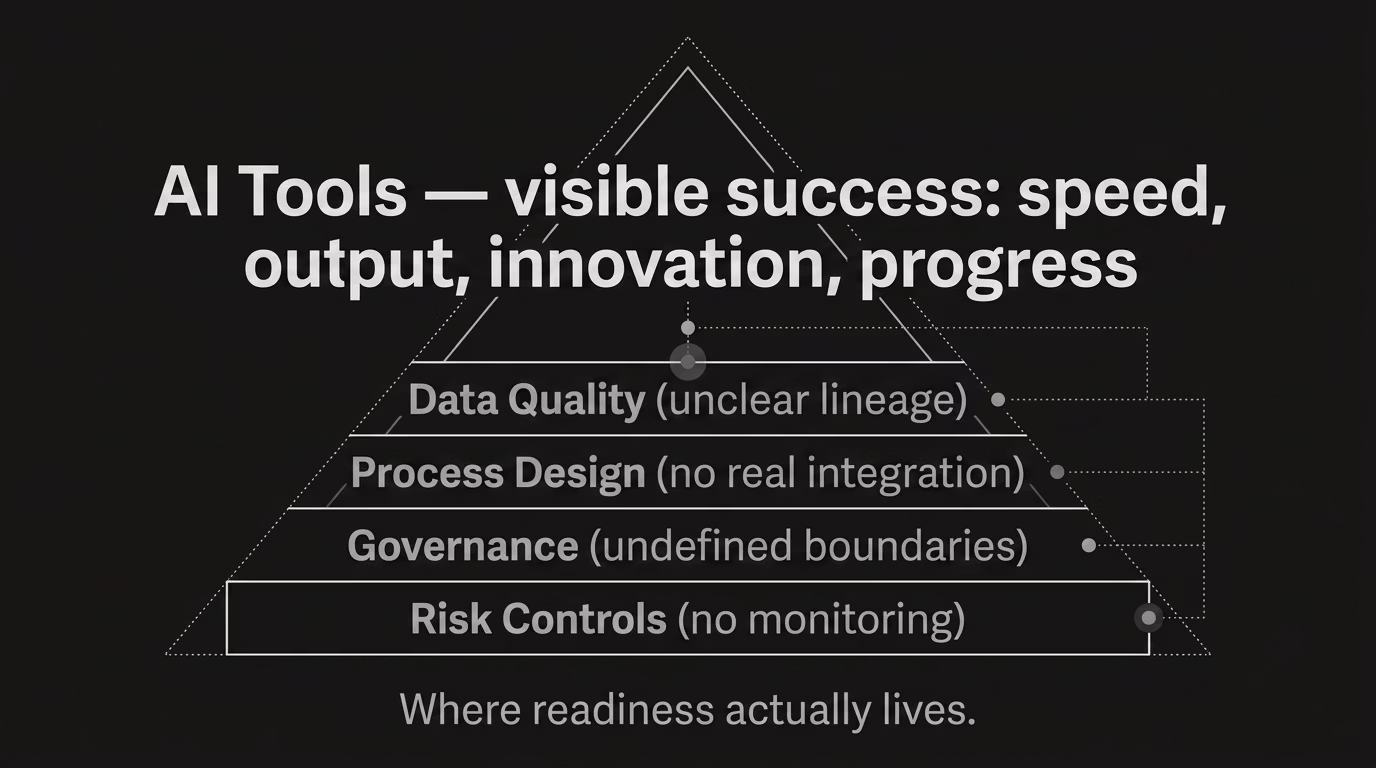
What the Pilot Shows
Speed
Innovation
Output
Progress
What the Pilot Hides
Unclear Data Lineage
Missing Governance
Weak Ownership
No Monitoring
Readiness Model
AI Readiness Is Not One Question
Readiness is not binary. An institution may be ready to experiment but not scale, ready internally but not externally, ready for assistance but not for decision influence. True readiness is a combination of seven disciplines.
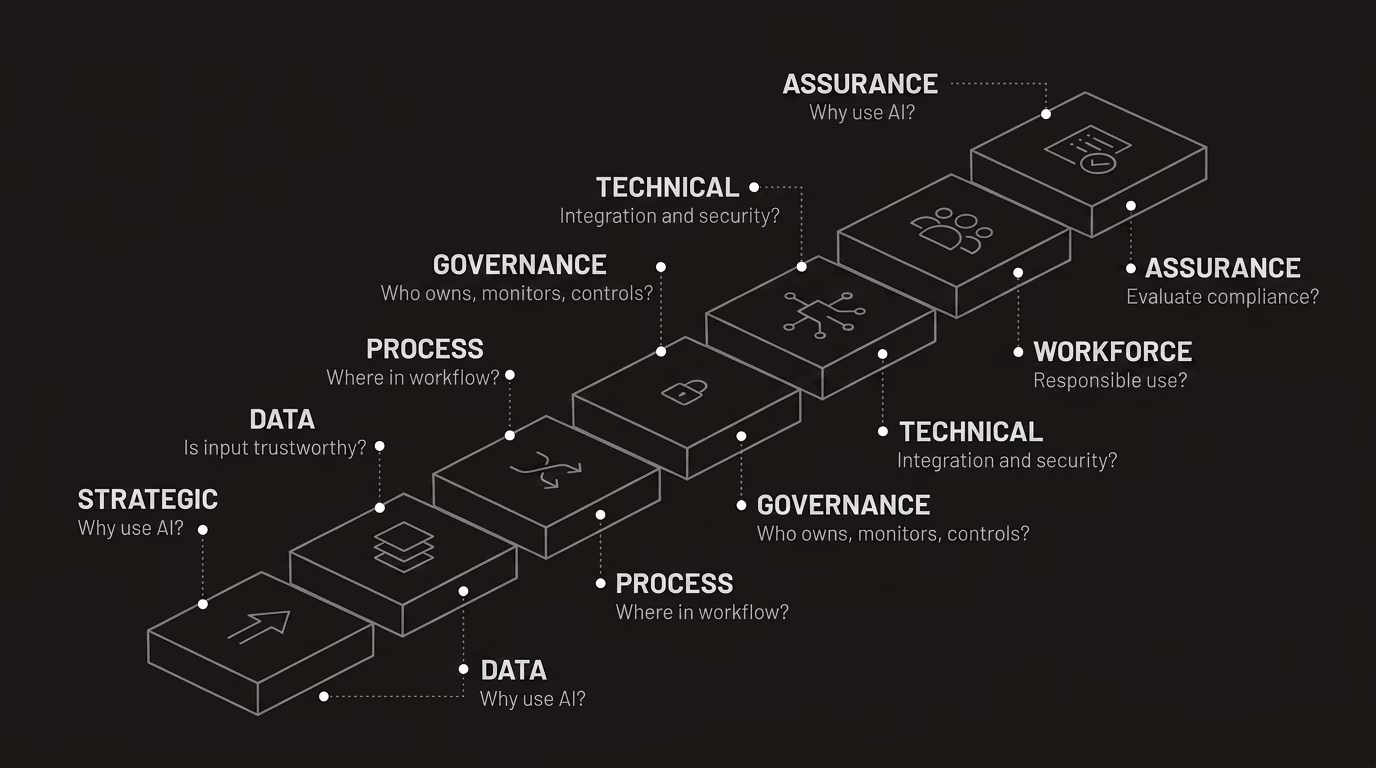
A pilot proves none of these seven dimensions. Each must be assessed independently before scaling.
Risk Analysis
Where the Real Risk Appears
Misinterpreting readiness creates five compounding risks that escalate from investment misalignment to institutional trust erosion.
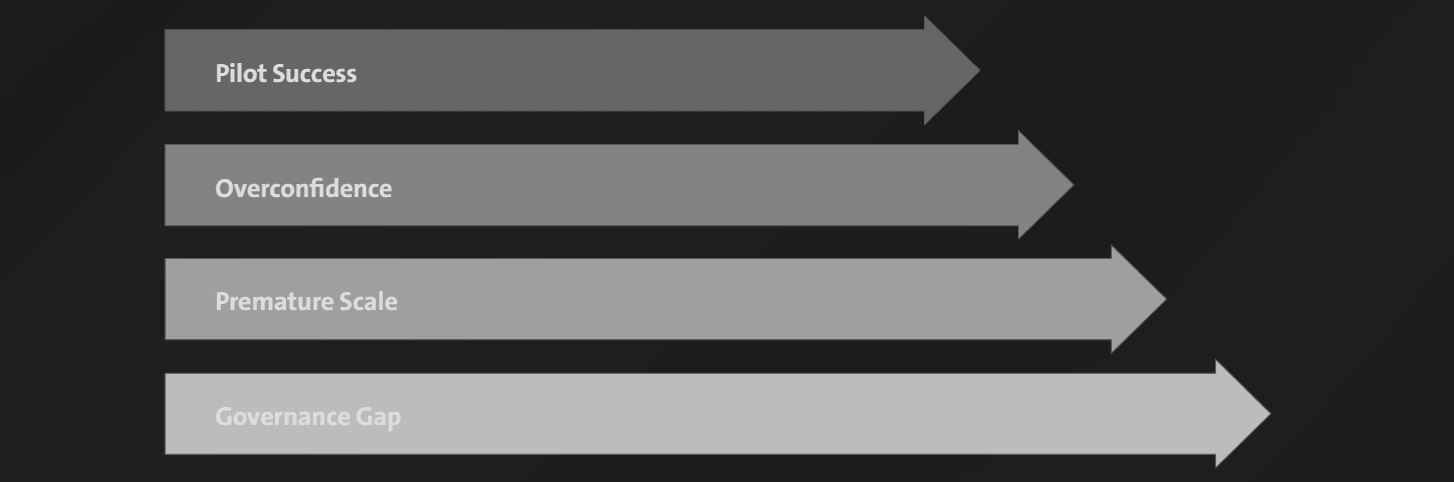
Misdirected Investment
Tools are scaled before the institution is ready → tool-rich, design-poor organization.
Pilot Theatre
Disconnected use cases across departments → no unified value or governance model.
Shadow AI
Employees use tools informally → usage expands faster than control.
Blurred Accountability
No clarity on who owns AI-driven outcomes.
Trust Erosion
Inconsistent outputs and overpromising reduce confidence in both the tool and the institution.
Diagnostic
Signs of False Readiness
These are not signs of progress. They are signs of misalignment between visible enthusiasm and structural preparedness.
Strong Enthusiasm, Weak Problem Definition
Energy without direction is not readiness.
Pilots Launched Without Ownership
No named accountable party for outcomes.
Unclear Data Quality
Inputs are unverified or fragmented.
No Distinction: Assistive vs. Decision AI
Risk level is not calibrated to use case type.
Weak Monitoring and Logging
No visibility into what the model is doing.
Compliance Involved Too Late
Risk function is reactive, not embedded.
Internal Audit as Reassurance
Used to validate rather than independently assure.
If three or more of these signs are present, the institution is not ready to scale — regardless of pilot results.
Institutional Comparison
The Right Question Changes Everything
A well-governed website performs critical institutional roles that extend far beyond communication.
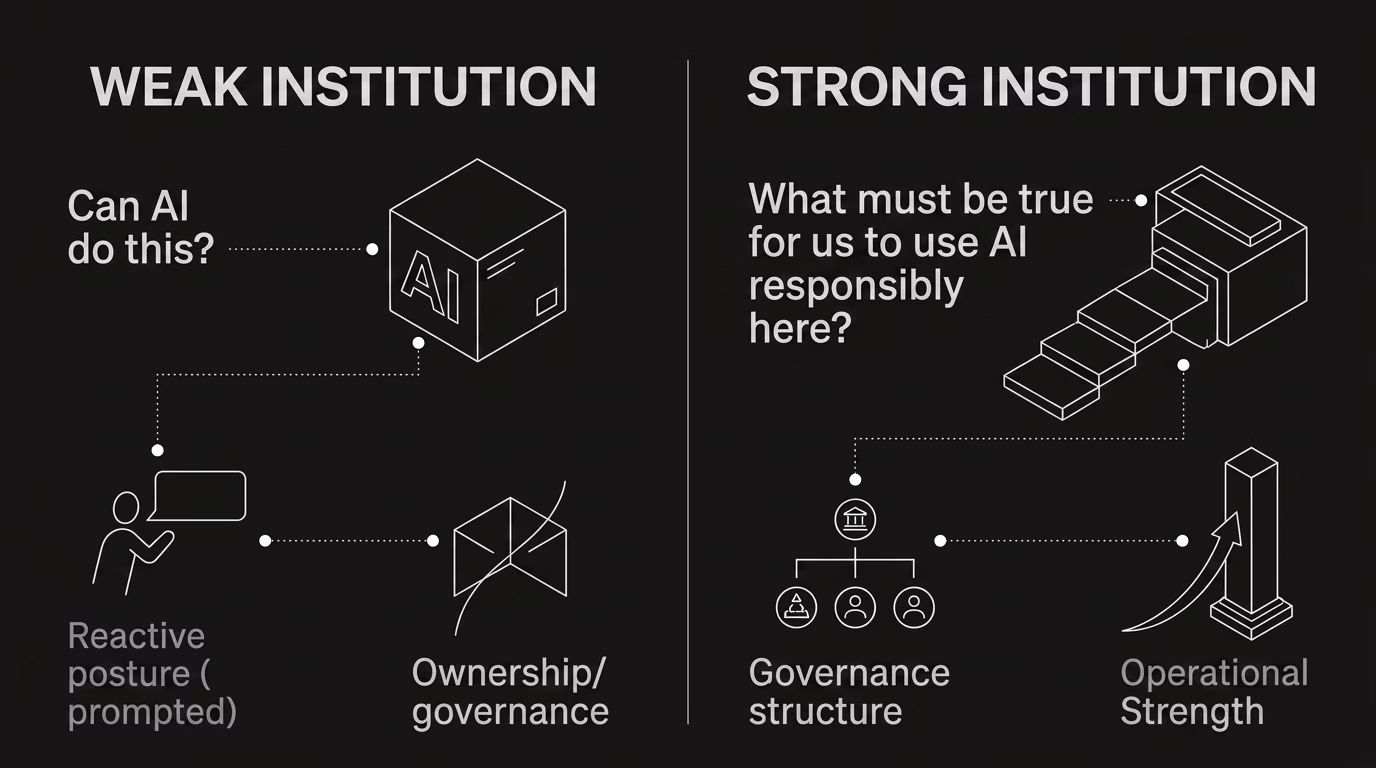
Weak institutions ask:
“Can AI do this?”
Strong institutions ask:
“What must be true for us to use AI responsibly here?”
This shifts the focus from capability to conditions — ownership, accountability, risk tolerance, human oversight, traceability, and governance. That is where real readiness begins.
Execution Framework
What Strong Institutions Do Differently
Operating Principles
→ Classify use cases by impact
→ Assign clear business ownership
→ Design human oversight explicitly
→ Involve governance early
→ Build monitoring before scaling
→ Train judgment, not just usage
→ Keep internal audit independent
They treat AI as operating model design, not feature deployment.

Month 1 — Map
Map and classify all AI use cases across the institution. Identify risk levels, ownership gaps, and data dependencies.

Month 2 — Design
Design one use case properly: assign ownership, validate data, define oversight model, establish controls and monitoring framework.

Month 3 — Evaluate
Run, observe, and evaluate: quality, errors, user behavior, and control gaps. Document findings before any expansion decision.
Then scale based on operational strength — not demo success.
Final Insight
AI maturity is not the ability to
demonstrate something impressive.
It is the ability to use AI in a way that remains controlled, understood, governed, and trusted — after the pilot ends.
AI Adoption
Deploying tools that work in a demo. Scaling on enthusiasm. Measuring success by output volume.
AI Readiness
Building the institutional conditions to sustain AI responsibly. Measuring success by governance strength and trust durability.
“AI readiness is not about what the tool can do. It is about what the institution can sustain.”